
How casino games work: chance, rounds and outcomes
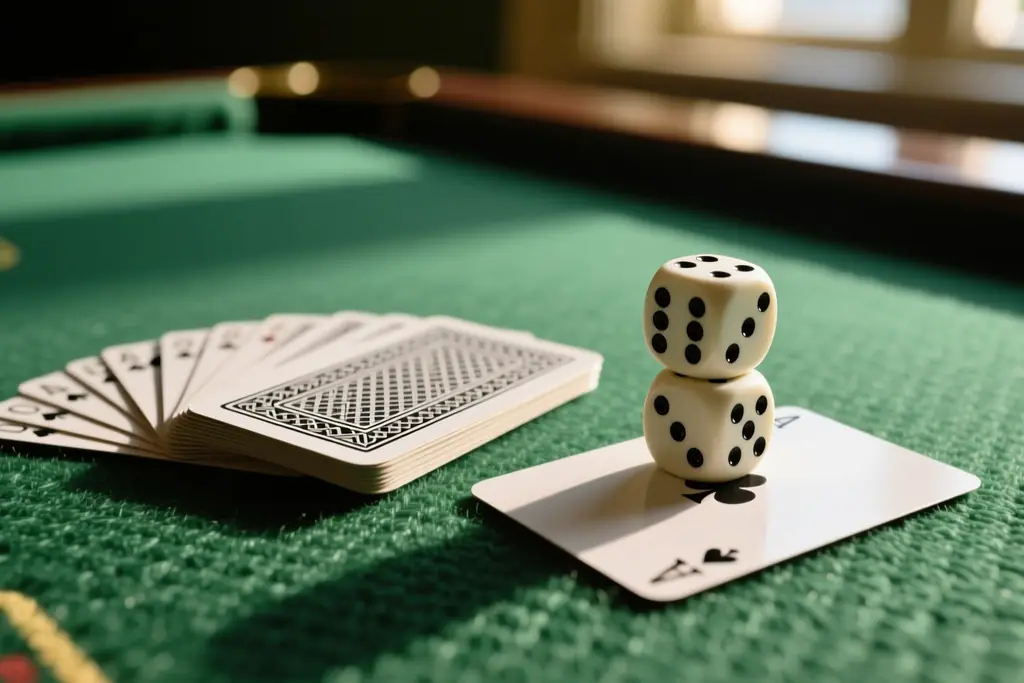
Casino games are built on chance. Whether the screen shows reels, a wheel or a rising multiplier, the outcome is produced by a random process inside the software, not by the sequence of previous results. Understanding that single idea removes most of the myths that surround the lobby. This page explains rounds, randomness and the honest way to think about the house edge.
Random results and independent rounds
Software games use a random number generator, a component designed to produce unpredictable outcomes. Each round is generated independently, which means the result of the previous round has no influence on the next one. A slot that has not paid for a while is not due to pay; a crash game that ended early is not preparing a long round.
Physical randomness works the same way in spirit. A coin does not remember its last toss. Once you accept that, the idea of a hot or cold game becomes what it really is: a story we tell about random events.
What a round means
A round is one complete cycle of a game, from the moment you commit a stake to the moment the outcome is settled. In a slot, a round is a spin. In a crash game, a round runs from take-off to the moment the multiplier stops. In a table game, a round is one deal or one spin of the wheel.
Rounds matter because they define your decision points. Between rounds you can stop, change the game or lower your stake. Inside a fast round you often cannot, which is exactly why fast games reward a plan made in advance.
Why past results do not predict the next one
- A long losing streak does not create a coming win.
- A pattern on screen is a description of the past, not a forecast.
- Round histories show what happened, not what will happen.
- Any system claiming to read the next result is a red flag.
The house edge in plain words
Every commercial game is built so that, over a very large number of rounds, the operator keeps a small share. That share is the house edge. It does not appear in any single round, and it does not announce itself in a session. It simply means that the longer you play, the more the maths works against you.
This is why no strategy can turn a game of chance into a source of income. Strategies can only change how long your budget lasts and how volatile your session feels. They cannot change the underlying expectation, and no promo code or prediction can guarantee a win.
| Idea | Common myth | What is actually true |
|---|---|---|
| Hot and cold | A game that has not paid is due | Rounds are independent |
| Patterns | You can read the next result | History describes the past only |
| Systems | A method removes the risk | Systems change tempo, not odds |
| Recovery | Doubling brings your money back | It increases the stake and the risk |
Keeping expectations realistic
Approach casino games as paid entertainment. Decide in advance what a session is worth to you, and treat that money as spent the moment you start. Anything you win back is a bonus; anything you lose was the price of the evening. That framing keeps the hobby a hobby.
If the maths behind a game is unclear, ask before you play. Operators publish rules and help pages for exactly this reason, and reading them is the most useful habit a new player can build.
Stake, balance and the size of a session
Your balance is a store of value, not a score. Each round spends part of it according to your stake, and the result returns more or less than that stake. The size of the stake therefore decides two things at once: how quickly the balance moves and how long a session can last.
A smaller stake stretches a session but increases the number of rounds needed to feel any result. A larger stake compresses the session into fewer, sharper swings. Neither choice improves your expectation; they simply produce different shapes of the same afternoon.
Why fast games need slower decisions
When rounds resolve in seconds, your decisions repeat before you have time to reflect. That is why a plan made in advance is worth more in a crash game than in a slow table game. In a slow game you can think between rounds; in a fast one, the thinking has to happen before you start.
The practical rule is simple: the faster the game, the shorter the session and the smaller the stake should be. Speed is the variable most likely to erode a plan, and almost all of it is under your control.
There is a version of this page that promises a method and another that promises nothing. The honest version is this one: outcomes are random, the operator retains a small edge over time, and your only real levers are stake size and how long you play. Those levers are not exciting, and they are enormously more useful than any pattern someone claims to have spotted.
If you remember a single sentence, remember this: a game of chance is entertainment with a price. Plan the price before you start, treat it as spent, and everything else about the session becomes simpler. That attitude also removes the disappointment that comes from expecting income from something that was never designed to provide it.
Chance is not a problem to be solved. It is the nature of the game, and accepting it is what separates a calm player from a frustrated one.
Read next
What a games portal is and how to read it
The difference between an operator and an information portal, and what to look for.
Crash games explained for beginners
What a multiplier curve is and why cashing out is always your own decision.
Casino terms explained without jargon
Lobby, round, multiplier, cash out, wagering — a plain-language glossary.